
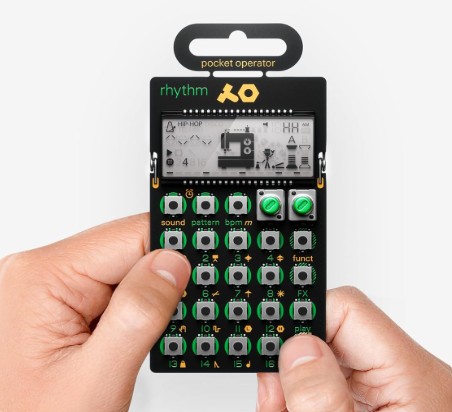
Teenage Engineering’s Pocket Operators are small, affordable, and surprisingly powerful music-making machines. They’ve become cult favorites because of their playful design, quirky animations, and portable battery-powered form factor. Within the range, several models are dedicated to drums, percussion, and beat-making. Deciding between them can be tricky, as each one has its own sonic character and workflow.
This guide compares the main drum-focused Pocket Operators: PO-12 Rhythm, PO-24 Office, PO-32 Tonic, and PO-33 K.O! By the end, you’ll know which one suits your style of production and performance.
What They Share
All Pocket Operators share some core features:
- Palm-sized form factor with exposed circuit board
- Battery-powered (2x AAA batteries, with long life)
- Built-in speaker and 3.5mm line input/output
- Sync function so you can chain multiple POs together
- 16-step sequencer with 16 pattern slots
- Real-time and step recording
- Punch-in effects for live manipulation
- Parameter locks (automation of knob movements per step)
This consistency makes it easy to jump between models. Once you know one, you’ll feel at home with the rest.
The Differences
The key differences lie in the sound engines:
- PO-12 Rhythm: Classic drum machine sounds (kicks, snares, hats, toms).
- PO-24 Office: Percussion based on office equipment noises (printers, typewriters, scanners).
- PO-32 Tonic: Fully synthesized drum sounds powered by Sonic Charge MicroTonic, with the ability to load new kits.
- PO-33 K.O!: A micro-sampler with 40 seconds of memory, split into drum and melodic slots.
Model by Model Breakdown
PO-12 Rhythm: The Instant Classic
The PO-12 is the most straightforward drum machine in the lineup. It delivers classic electronic percussion that’s punchy and mix-ready. Think 808/909-inspired kicks and snares, hi-hats, claps, and toms.
Strengths:
- Extremely quick to get ideas down
- Classic drum-machine palette that fits into almost any style
- Parameter locks and effects keep patterns lively
Considerations:
- Fixed sound set—you can’t load your own samples or design new kits
- May feel limited over time if you want more variety
Best for: Beginners, or anyone who wants a pocket-sized drum machine that “just works.”
PO-24 Office: Foley Percussion and Glitchy Rhythms
The PO-24 takes a completely different approach. Instead of traditional drums, it uses sounds of office machinery—typewriters, printers, scanners, calculators—as percussion. The result is quirky, industrial, and very characterful.
Strengths:
- Unique textures not found in any other drum machine
- Perfect for experimental, glitch, or industrial music
- Supports chaining up to 128 patterns for long, evolving arrangements
Considerations:
- Not ideal if you need straightforward kicks and snares
- Works best as a companion to a more traditional drum machine
Best for: Producers who want to stand out with unusual sounds and longer structured sets.
PO-32 Tonic: The Sound Designer’s Drum Synth
The PO-32 is powered by Sonic Charge MicroTonic, a respected drum synthesis engine. Each of its 16 slots is a fully synthesized voice, capable of being shaped into anything from booming kicks to futuristic zaps. Its killer feature is the ability to load entirely new kits and patterns via audio transfer. You can design in MicroTonic on your computer and send the data to the PO-32 over the line input or even through its built-in mic.
Strengths:
- Infinite sonic potential—refresh with new kits anytime
- Deeper sound design possibilities than any other PO
- Powerful bridge between DAW and handheld hardware
Considerations:
- Requires MicroTonic software to unlock its full potential
- Slightly more learning curve than the PO-12
- Loading a new kit overwrites the old one, so planning is important
Best for: Producers who love drum synthesis, sound design, and evolving kits.
PO-33 K.O!: The Sampler
The PO-33 is a micro-sampler. It gives you 40 seconds of memory and lets you record sounds through its built-in mic or via line input. You get 16 slots: 8 for drum sounds and 8 for melodic samples. You can chop up a breakbeat, record your voice, or pull sounds from your favorite tracks.
Strengths:
- Totally customizable kits—your sounds, your beats
- Easy sampling through the built-in mic
- Perfect for lo-fi, hip-hop, or experimental textures
Considerations:
- Limited to 40 seconds of memory
- No removable storage—everything lives on the device until you replace it
- Requires some preparation to build a good kit
Best for: Beatmakers who want their own sounds in a handheld groovebox.
Workflow Across All Models
All Pocket Operators use a 16-step grid sequencer. You select a sound, place it on the steps, and play it back. You can record live or step-by-step. Parameter locks let you change pitch, decay, or filter on individual steps. Punch-in effects add stutters, filters, and glitch tricks, either temporarily or automated.
The consistency means once you’ve learned one, you can jump between the others easily.
Sound Character
- PO-12 Rhythm: Clean, classic, electronic drums
- PO-24 Office: Quirky, mechanical, noisy percussion
- PO-32 Tonic: Deeply programmable, synthesized drums
- PO-33 K.O!: Whatever you want—samples define its character
Connectivity and Sync
All Pocket Operators have 3.5mm I/O for chaining. You can daisy-chain audio and clock sync, making it easy to run several at once. PO-32 stands out with its built-in mic, which allows audio data transfer for kit loading. Otherwise, connectivity is simple and uniform across the range.
Durability and Portability
The exposed PCB look is intentional. Despite their bare-bones appearance, they are fairly rugged. A folding stand lets them sit upright on a desk, and their quirky LCD animations add charm. They’re incredibly portable and run for hours on two AAA batteries.
Which One Should You Get?
- If you’re brand new: Start with the PO-12 Rhythm. It’s the most immediate and teaches you the Pocket Operator workflow.
- If you’re a sound designer: Get the PO-32 Tonic. With MicroTonic, you’ll never run out of new sounds.
- If you’re a sampler: Go for the PO-33 K.O! It’s the most flexible for custom beats.
- If you’re experimental: The PO-24 Office offers unique sounds and long pattern chains.
Pairing Pocket Operators
Pocket Operators work best in pairs or trios:
- PO-32 + PO-33: Synthesis plus sampling for ultimate flexibility.
- PO-12 + PO-24: Classic drums plus quirky textures.
- PO-12 + PO-33: Quick beats plus your own sampled kits.
Creative Workflows
- PO-12 Groove Idea: Program a basic kick/snare/hat pattern, then use parameter locks to vary decay and pitch. Add punch-in stutter effects for fills.
- PO-24 Industrial Beat: Chain multiple patterns together with printer and typewriter hits. Use step multipliers for rhythmic variation.
- PO-32 Kit Refresh: Load a new MicroTonic kit before a live set for fresh sounds.
- PO-33 Break Chop: Sample a breakbeat, slice it across the drum slots, and rearrange into your own rhythm.
Final Verdict
Each drum-focused Pocket Operator brings something unique:
- PO-12 Rhythm: The most immediate classic drum machine.
- PO-32 Tonic: The deepest and most flexible for sound design.
- PO-33 K.O!: The sampler that becomes whatever drum machine you want.
- PO-24 Office: The quirky, industrial choice for experimental grooves.
If you can only buy one, base your choice on whether you want instant results (PO-12), infinite sonic variety (PO-32), personal samples (PO-33), or left-field character (PO-24). If you can stretch to two, pairing a conventional drum machine with either the sampler or the office-noise unit gives you a compact setup that covers both reliable beats and unique textures.
The beauty of Teenage Engineering’s drum-focused Pocket Operators is that they’re small, affordable, and highly complementary. Many producers end up collecting more than one because each adds a distinct flavor. No matter which you choose, you’re getting a fun, creative, and surprisingly powerful drum machine that fits in your pocket.