
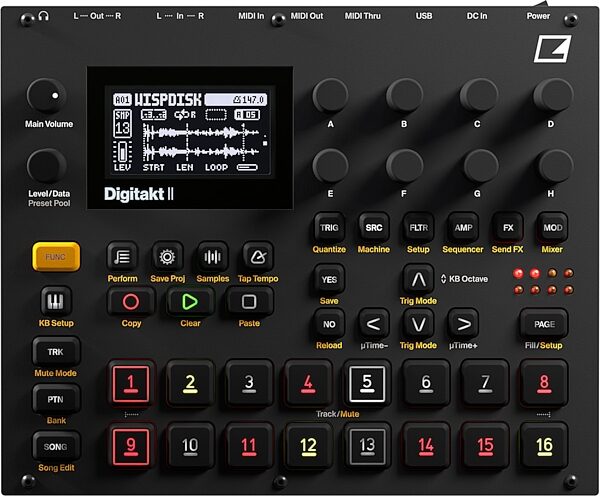
Few pieces of gear in the last decade have sparked as much excitement among electronic musicians as the Elektron Digitakt. Released in 2017, it quickly became a go-to choice for producers, live performers, and beatmakers who wanted a powerful yet portable drum machine and sampler. With Elektron’s signature workflow, deep sequencing power, and a compact design, the Digitakt has built a reputation as a modern classic. But is it still worth picking up today? This review will break down its design, features, workflow, sound quality, strengths, and limitations so you can decide if it deserves a place in your setup.
Design and Build
The Digitakt has a compact, boxy design that feels sturdy and professional. It’s built like a tank — the kind of hardware you’d trust to take on the road without worrying about it breaking down. The matte black chassis, crisp OLED display, and tactile buttons give it a no-nonsense, performance-ready feel.
Despite its relatively small footprint, it’s not cramped. The buttons are firm and satisfying, the encoders are smooth, and the backlit keys are easy to navigate in both studio and stage lighting. Elektron has always had a reputation for durable gear, and the Digitakt continues that tradition.
Weighing in at under 1.5 kg, it’s light enough to carry around, making it a portable yet serious production tool. Many artists throw it in a backpack alongside a small synth or MIDI controller and have a complete live rig ready to go.
Core Features
The Elektron Digitakt is both a drum machine and a sampler, giving it a dual identity. At its core, it offers eight audio tracks for samples and eight MIDI tracks for sequencing external gear. This flexibility is one of its biggest strengths, allowing you to use it as the heart of a live rig or a central hub in the studio.
- Sample Playback and Editing: You can load your own samples via USB or use the included factory sounds. Once inside the machine, samples can be chopped, looped, reversed, time-stretched, and pitched. The editing tools are powerful and invite experimentation.
- Sequencing Power: The Elektron sequencer is legendary, and the Digitakt delivers on that reputation. You can add parameter locks to almost every knob turn, meaning each step in a sequence can have different filter settings, sample choices, or effect levels. This allows you to create evolving, complex patterns that would be hard to replicate on other machines.
- MIDI Sequencing: With eight dedicated MIDI tracks, you can control external synths, drum machines, or software instruments. Each track supports multiple CC messages, program changes, and advanced sequencing options. For live performers, this makes the Digitakt a powerful command center.
- Effects: Built-in effects include reverb, delay, bit reduction, and overdrive. While they aren’t the deepest effects suite on the market, they’re tuned to sound musical and work well with drum programming and sampling.
- Storage and Connectivity: The Digitakt comes with 1 GB of sample storage and 64 MB of RAM per project. It features USB connectivity for file transfer and integration with Elektron’s Overbridge software, which lets you stream audio directly into your DAW. On the back panel, you’ll find stereo inputs, stereo outputs, a headphone jack, and MIDI in/out/thru.
Workflow and User Experience
The Digitakt workflow is both its biggest strength and, for some newcomers, a hurdle. Elektron gear has always leaned toward a deep, menu-driven design philosophy. While the learning curve can be steep, once you understand the structure, it becomes second nature.
Creating patterns is quick: load a sample, assign it to a track, and lay down a beat using the step sequencer or real-time recording. Where the Digitakt shines is in its parameter locking system. For example, you can make one snare hit drenched in reverb while the next is completely dry, all within the same track. This micro-level control makes it possible to craft intricate, evolving rhythms without using tons of extra gear.
Live performance is another area where the Digitakt excels. Its pattern chaining, song mode, and ability to mangle samples on the fly give performers a lot of freedom. You can drop in effects, adjust filters, and tweak parameters in real time, turning a pre-programmed beat into something fresh and unpredictable.
For beginners, the initial navigation might feel overwhelming, but Elektron’s manuals, tutorials, and community support make learning more accessible than it used to be. And the payoff is huge: once you grasp the basics, the Digitakt becomes an intuitive and inspiring creative partner.
Sound Quality
The Digitakt has a clean, punchy sound engine that makes it versatile across genres. Whether you’re making hip-hop, techno, house, ambient, or experimental music, the machine delivers. Its 24-bit audio engine ensures clarity, while the filters and overdrive add grit when needed.
The reverb and delay are lush enough to create space and atmosphere, though they’re not as customizable as standalone effect units. Still, in the context of drum programming and sampling, they add plenty of depth. The bit reduction effect is a favorite among producers who like to add lo-fi textures or vintage character.
Because it’s sample-based, the Digitakt’s sonic identity is shaped by what you put into it. The included factory sounds are solid, but the real magic happens when you load your own libraries. With careful editing and creative use of effects, it can sound massive, dirty, or delicate — whatever your track needs.
Strengths
- Portability and build quality: Rugged, lightweight, and ready for studio or stage use.
- Powerful sequencer: Parameter locks and MIDI sequencing make it a true creative powerhouse.
- Sampling flexibility: Easy to load, edit, and manipulate samples.
- Performance-friendly: Great for live improvisation and pattern variation.
- Integration with DAWs: Overbridge support makes it easier to use in hybrid setups.
Limitations
- No song mode at launch: Early units lacked it, though updates improved functionality.
- Learning curve: The Elektron workflow isn’t instantly accessible to everyone.
- Limited polyphony: Each track is monophonic, so chords require some creative sequencing or external gear.
- Effects limitations: Useful but not as deep as dedicated processors.
- No time-stretch at first release: Later firmware updates added more functionality, but it’s not as fluid as some modern samplers.
Who Is It For?
The Digitakt is ideal for producers who want a compact but deep groovebox. If you love building beats from samples, experimenting with evolving patterns, or integrating hardware synths into your setup, the Digitakt is perfect. It’s also a dream machine for live performers who want hands-on control and improvisational flexibility.
Beginners who want instant gratification might initially struggle, but those willing to put in the time will find it incredibly rewarding. If your goal is to quickly sketch song ideas without deep menu-diving, you might be better off with a more straightforward sampler or groovebox. But if you want depth and long-term creative growth, the Digitakt is hard to beat.
Final Verdict
The Elektron Digitakt has earned its reputation as one of the most important drum machines and samplers of the modern era. It combines portability, power, and flexibility in a way that few other machines do. Its sequencer is unmatched in terms of depth, its build quality inspires confidence, and its ability to serve as both a sampler and a MIDI brain makes it a versatile centerpiece for many setups.
Yes, it has quirks: a learning curve, some limitations in effects, and monophonic tracks. But those quirks also push you to think creatively. The Digitakt doesn’t spoon-feed ideas — it encourages exploration, experimentation, and performance.
Whether you’re in the studio crafting beats or on stage bringing patterns to life, the Digitakt proves itself again and again as a powerful creative tool. Years after its release, it remains highly relevant and continues to attract a loyal following. If you’re looking for a drum machine and sampler that rewards patience with endless possibilities, the Elektron Digitakt deserves a serious look.