
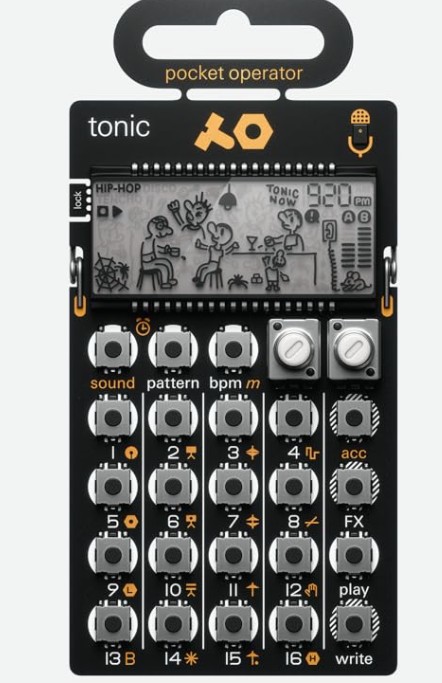
When it comes to compact, fun, and surprisingly powerful drum machines, Teenage Engineering’s Pocket Operators have carved out a cult following. Among them, the PO-32 Tonic stands out as a unique entry: a micro-sized drum synth that merges quirky design with serious sound-design capabilities. It’s not just a pocket toy – this little device packs enough punch to rival larger and more expensive drum machines, thanks to its deep programmability, versatile sonic palette, and integration with Sonic Charge’s Microtonic software.
In this review, we’ll dive into what makes the PO-32 Tonic special, its features, usability, pros and cons, and whether it deserves a place in your studio setup.
First Impressions
The first thing you notice with the PO-32 Tonic is its unmistakable design. Like all Pocket Operators, it has an exposed circuit-board aesthetic with a minimal layout. It’s about the size of a calculator, powered by two AAA batteries, and has a tiny LCD display with quirky animations that bring character to the experience.
Despite its toy-like appearance, the PO-32 is far from a gimmick. The moment you start tapping its buttons and twisting its knobs, you realize this is a serious instrument with a surprisingly deep feature set. For producers looking for portability and creativity on the go, it immediately feels like a playground for ideas.
Key Features
Here’s what the PO-32 brings to the table:
- 16 sounds and patterns – a set of percussive voices ready to be sequenced and tweaked.
- Full drum synth engine – unlike some other Pocket Operators, this isn’t just samples. It’s based on the Sonic Charge Microtonic engine, which allows deep sound sculpting.
- 16 effects – from bit-crushing to reverb-like effects, these instantly add character to your beats.
- Step sequencer – a 16-step pattern sequencer lets you build rhythms, with options for chaining patterns together.
- Parameter locks – the ability to lock knob movements per step, allowing intricate sound changes over a sequence.
- Sound transfer – you can transfer sounds and patches between the PO-32 and Sonic Charge Microtonic via audio data – literally by holding the device up to your computer speakers.
- Portable design – battery-powered with built-in speaker and line out, it’s designed for both couch jamming and studio integration.
These features position the PO-32 as one of the most capable Pocket Operators in Teenage Engineering’s lineup.
Sound Quality
Where the PO-32 truly shines is in its sound. Many drum machines in this price range rely on pre-loaded samples, which can feel limiting. The PO-32 instead uses a genuine drum synthesis engine. This means you’re not stuck with the same set of kicks, snares, and hi-hats – you can actually shape your own.
The kicks can be made deep and booming or sharp and punchy. Snares can range from tight and snappy to glitchy and noisy. Hats and percussive sounds can go from crisp metallic to lo-fi grit. The 16 effects take things even further, adding layers of unpredictability and character.
One standout aspect is how “big” it sounds despite its tiny frame. Run it through a proper set of speakers or headphones and you’ll quickly realize it can hold its own against drum machines several times its size and cost.
Workflow and Usability
Like all Pocket Operators, the PO-32 has a learning curve. With only two knobs, a handful of buttons, and a calculator-sized display, the interface is compact. But Teenage Engineering has managed to squeeze in a surprisingly fluid workflow once you get the hang of it.
Building patterns is straightforward: choose your sound, input it into steps on the sequencer, and tweak parameters. Parameter locks allow each step to have unique values for pitch, decay, or filter settings, which is where the real magic happens. You can create evolving, intricate rhythms that sound far more complex than the device’s size suggests.
The effects are applied in real time, so you can “play” them like performance tools, great for live sets. And chaining patterns lets you construct longer sequences for entire tracks.
Where things get particularly interesting is the integration with Microtonic. If you own the software, you can design custom drum patches on your computer, then transfer them to the PO-32 by playing an audio data burst into its microphone. It’s a clever solution that extends the instrument’s sonic life far beyond its stock sounds.
Portability and Build
The PO-32 is built to be carried everywhere. Slip it into a pocket or backpack, and you’ve got a drum machine that runs for hours on AAA batteries. The built-in speaker isn’t studio quality, but it’s loud enough for casual jamming. Plug it into headphones or a mixer, and the sound quality jumps up dramatically.
The circuit board design may look fragile, but it’s sturdier than it appears. Still, many users opt to buy a protective case or third-party enclosure to make it more road-worthy. The exposed buttons and screen can take some abuse, but if you’re planning on gigging with it, a case is recommended.
Integration with Other Gear
Although it’s self-contained, the PO-32 plays well with others. It has sync in/out options, meaning you can chain it with other Pocket Operators, or sync it to gear like the Korg Volca series or DAWs. This makes it great for live performance setups, where you can have multiple devices locked together in tempo.
The audio output is standard 3.5mm, so it connects easily to mixers, interfaces, or portable recorders. Combined with Microtonic integration, this makes it not just a toy, but a tool that can fit into professional workflows.
Strengths
- Huge sound in a tiny package – the synthesis engine gives it serious punch.
- Deep programmability – parameter locks and Microtonic support make it flexible.
- Affordable – compared to full-sized drum machines, it’s budget-friendly.
- Portable and fun – small, battery-powered, and instantly playable.
- Great for inspiration – its quirks often lead to creative results.
Weaknesses
- Limited interface – the small screen and button combo can be fiddly.
- No USB or MIDI – syncing is limited to audio pulse sync, which may frustrate some.
- Fragile design – the exposed board isn’t ideal for heavy touring without protection.
- Learning curve – beginners may find the workflow confusing at first.
Who Is It For?
The PO-32 Tonic appeals to a wide range of users:
- Beginners who want an affordable way into drum machines.
- Producers on the go looking for a portable sketchpad for rhythms.
- Live performers who want a fun, glitchy, and playable drum machine on stage.
- Sound designers who want to experiment with Microtonic’s deep synthesis in hardware form.
If you’re looking for polished, menu-driven control or traditional MIDI integration, you might be better served with larger machines like the Roland TR-6S or Elektron Model:Samples. But if you embrace the quirky charm of Pocket Operators, the PO-32 Tonic offers something uniquely rewarding.
Comparison to Other Pocket Operators
Compared to its siblings, the PO-32 is more advanced than the sample-based PO-12 Rhythm or PO-24 Office. Those are fun, but limited to their built-in sounds. The Tonic’s Microtonic engine gives it far more depth.
It’s also one of the few Pocket Operators that can accept external patch transfers, giving it a near-infinite lifespan in terms of sound design. This makes it more versatile than many other models in the lineup.
Verdict
The Teenage Engineering PO-32 Tonic is proof that big things can come in small packages. It combines quirky design with serious sound capabilities, bridging the gap between playful gadget and professional instrument.
While it has limitations – no MIDI, fragile build, and a fiddly interface – its strengths far outweigh its drawbacks. For the price, it’s an incredibly inspiring tool that can serve as a drum machine, sound design playground, and performance device all in one.
Whether you’re an experienced producer or a curious beginner, the PO-32 Tonic deserves attention. It’s one of the best examples of Teenage Engineering’s philosophy: making music fun, portable, and endlessly creative.